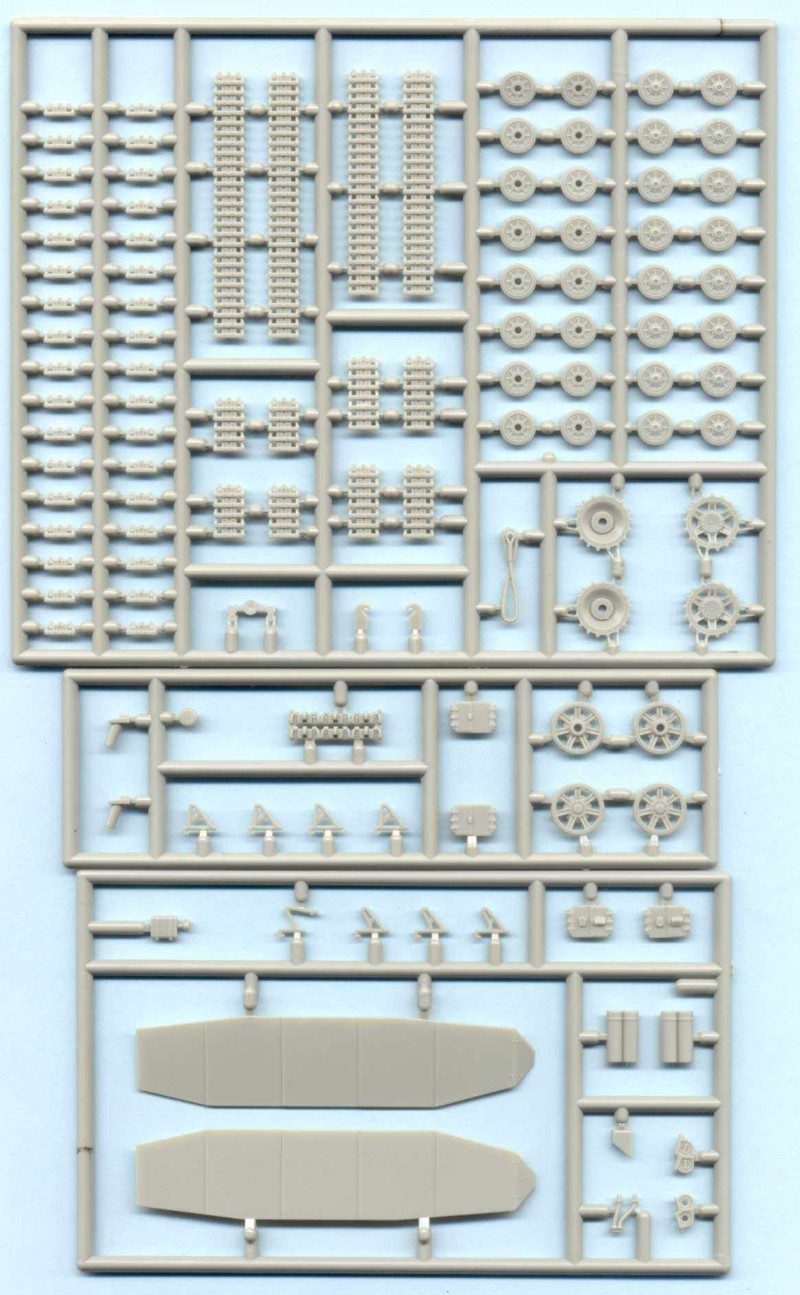
| Introduction
Nashorns
had a lot in common with the Hummel SPG. Whereas the Hummel carried
a 150mm howitzer, the Nashorn wielded an 88mm anti-tank gun. A total
of 494 Nashorns were produced from February 1943 to March 1945, and
were used to equip independent Pz.Jg.Abt., according to [1].
Most (345) of those were produced in 1943, with smaller production
runs continuing into 1945.
Originally, they were called Hornisse, before a name change to Nashorn
in 1944. Modelers often use these names to distinguish early from
later vehicles. As the name change was applied retroactively by the
Wehrmacht, only Nashorn will be used in this article.
Modelers
looking for diorama options should know that none were used in Afrika,
in the battle of Kursk, Normandy or the Ardennes. Actually, on the
Western front they first appeared in the Alsace campaign.
The
evolution of the Nashorn was as follows [1,3]:
- An
armored shield on top of the gun was added in February 43.
- Very
early vehicles had armored covers from the PzKpfw III for the brake
vents. These were replaced by larger items in March 43.
- Aiming
stakes were omitted in March 43.
- A
heating vent for the crew compartment was added in March 1943. I
believe this is Part 32.
- Early
vehicles had the drive sprocket of the Pz.Kpfw. III Ausf. E, with
round holes, rubber return rollers of the Pz.Kpfw. IV Ausf. D and
idler of the Pz.Kpfw. IV Ausf. F. Starting in March 43 the drive
sprockets came from the Pz.Kpfw. III Ausf. J, with trapezoidal holes.
At first, this was only partially implemented.
- The
tow cables were repositioned in March 1943 and again in August 1943.
- Very
early vehicles had a slit in the gun shield for a sighting device.
This was omitted in April 43, but only partially at first. The flap
was welded shut on some vehicles between April 43 and August 43
and later totally omitted.
- Initially
a rear-fitted muffler (like the Panzer IV) was installed. In April
43 this was removed. The exhaust pipes now ran below the fenders
and the muffler was moved to the inside of the hull.
- In
April 43, the spare roadwheels were moved from the front to the
rear of the hull (using the space freed up by the new exhaust arrangement).
It seems that before this date, spare roadwheels were not a factory
feature, but many units added roadwheels to the armor at the front
of the fighting compartment (at slightly different positions) or
to the sides of the driver's compartment.
- In
April 43, the box below the rear fender was removed. It seems that
the mudflaps disappeared at the same time, although pictures can
be found of vehicles without boxes, but with mudflaps.
- In
April 43, tow hooks were added to the rear and the internal lifting
eye moved forward.
- Initial
vehicles had two Bosch headlights. In May 43 the right headlight
was removed.
- A
new barrel clamp appeared in May 43. The initial one had been styled
after that of the Hummel. At the same time the travel lock inside
the fighting compartment was dispensed with [3].
- A
loop was added over the recuperator cylinder just behind the gun
shield in May 43. (This is Part 76 in the kit, I assume.)
- For
other minor changes, I refer to [3].
- Befehls
(command) versions had an extra antenna on the right rear corner
of the fighting compartment.
- Some
vehicles had a prominent frame around the driver's front vision
flap.
- Some
units (like s.H.Pz.Jg.Abt. 560 and 655) sometimes added appliqué
armor to the gun shield.
Many
vehicles featured a mix of early and late characteristics.
The Revell
kit has the features of a Nashorn built from May 1943 onwards. In
that respect it is almost identical to Dragon
kit 7292.
Modelers who want to go off the beaten track might be interested to
learn that a few were fitted with Ostketten [1,4]. Extra armor was
also sometimes fitted to the gun shield. An interesting option to
build might also be the Nashorn captured and used by Canadian troops
in Italy, 1945 [2].
The wide compartment covering both driver and radio operator that
was a feature of later Hummels was never installed on the Nashorn,
neither was a switch to three return rollers implemented. Worth noting
for people who are considering a diorama setting is that the Pak43/1
of the Nashorn used the fatter round from the Flak 42 (Krupp), not
the one of the Flak 41 (Rheinmetall) [3].
Construction
The
first thing I noticed was that the construction sequence is somewhat
weird, at least in my opinion. Installing the complete running gear
on the lower hull before even starting to add parts of the upper hull
is not what I consider the easiest approach. I also decided to build
the whole gun assembly before fitting it to the completed fighting
compartment. It’s a tight squeeze, and it almost worked as planned
(more below). Following the instructions has you fit the gun before
certain armor plates of the fighting compartment are added, making
it almost impossible to paint the interior, I believe.
Even so, the parts go together rather well, in general.
_t.jpg)
_t.jpg)
_t.jpg)
_t.jpg)
_t.jpg)
_t.jpg)
_t.jpg)
_t.jpg)
_t.jpg)
_t.jpg)
Pictures
from Henk
of Holland website, used with
permission
Some further random thoughts regarding the construction.
The hull:
- Very
important, in my opinion, is to note that Parts 42 and 43
are not to be glued to the fighting compartment, but serve
as a jig to install Parts 32 in their correct position. I don’t
think this is mentioned in the instructions at all, and I missed
it. (Actually, the top left of Step 13 clearly says to use glue...)
_t.jpg)
Removing Parts 42 and 43 and cleaning up the glue marks was not
the most amusing part of this build. Moreover, having assumed that
Parts 42 and 43 were there to stay, I didn’t bother to fill
in the holes on the inside of the fighting compartment that are
directly opposite the return roller mounts. Filling them in on the
sprues would have been easy. Doing so once partially assembled and
close to the delicate ant-slip pattern on the floor plate, well,
not so much.
As this dis- and re-assembly process is not the best way to approach
building this kit, my assessment is probably skewed a bit. If I
ever build the second kit in my stash and come to different findings,
I’ll let you know.
- The
inside of the fighting compartment has some ejector marks that need
to be cleaned up.
- I
am not sure if Part 44 (a storage box) was really beveled in reality,
but this is almost invisible in the finished kit. What it does well
is hide ejector marks on the rear armor plate, though.
- Strangely,
the triangular support for the left armor plate of the fighting
compartment (Part 39) is molded in situ, while on the right side
it’s a separate part (Parts 38 and 51). Part 51 also has rivet
detail and a small peg that the fixed triangular plate on Part 39
lacks. I don’t know if this is correct.
- Note
that many vehicles had a mount for an (AA) machine gun inside the
fighting compartment. The kit doesn’t provide one and the
vehicle that I wanted to depict doesn’t require it.
- In
my opinion, the angle of the rear plate is too steep compared with
drawings and pictures. I angled the rear plate inwards a bit and
sanded down the edges of the side plates to match.
_t.jpg)
Rear
plate canted inwards; side plate not yet modified
- It
is correct that the sides of the fighting compartment (Subassembly
15 and 16) are a tad higher than the rear (Subassembly 17). The
corners at the rear of the side plates should be a bit more rounded,
though.
_t.jpg)
_t.jpg)
Original
kit part on the left; after sanding on the right
- I
spent a disproportionate amount of time on the joint between the
sides of the fighting compartment, the front of the fighting compartment
(Parts 86 and 87) and the driver’s compartment, especially
when it came to the small reinforcement strips in the lower corners.
I managed to achieve satisfaction but couldn’t muster the
courage to add tiny rivets to these strips. This is one of the reasons
why I think it is better only to install the front fenders (Parts
24 and 25) after finishing all the armor plates.
- Another
area where time was lost, was the joint between the upper half of
the rear plate and the lower half. I am not giving advice here,
as my method can surely not have been the best one.
_t.jpg)
- The
deflector (Part 85) also gave some trouble as managing a clear joint
is difficult due to the presence of rivets. Adding insult to injury,
it popped off when installing the complete gun assembly, forcing
me to do it over again, but now with a long-barreled gun poking
around as well.
- I
modified the front fenders by adding small strips to the edges to
create the typical step between fenders and the armor of the fighting
compartment (cf. box top and pictures below). While this works,
it creates interference with the tracks (of which more below). I
wonder if raising the sides of the fighting compartment a bit (Parts
38 and 39) wouldn’t have been easier.
_t.jpg)
_t.jpg)
Original
fenders
_t.jpg)
Modified fenders
- Do
not install the tow hooks the way they are shown in Step 3, but
with the opening upwards (as correctly shown in Step 14 and in the
marking options in Step 41 and 42).
_t.jpg)
- An
easy improvement is to hollow out the exhausts.
- Part
53 (cleaning rods) was a short shot in this kit. (I have another
kit, and there the part is flawless.)
- The
spare roadwheels mounted on the rear of the hull are supported by
hangers, which I fabricated from soldering wire. Since the vehicle
I intended to depict belonged to a unit that also carried an additional
spare roadwheel to the left of the driver’s compartment, I
added a corresponding extra hanger. Initially, I went a bit overboard
and prepared two additional spare roadwheels -one for each side-
only to realize just in time that only one was actually required.
Looking at pictures of vehicles of the unit I wanted to represent,
it might have been better to install it a tad lower.
These spare roadwheels were sourced from separate Revell
PzKpfw IV Ausf. H or J sprues purchased from Revell’s
Department X many years ago and feature the later, pressed-type
hubcaps. Having already prepared both wheels, I ultimately decided
to install them on the bogies to introduce some visual variation.
This choice is supported by historical evidence: the pressed-type
hubcaps were introduced in September 1943 [5], and period photographs
show Nashorns fitted with them on individual bogie stations. Consequently,
they are entirely appropriate for the vehicle I aimed to represent,
dating to the winter of 1943–1944.
_t.jpg)
_t.jpg)
- Having
prepared for this extra roadwheel, I discovered that it got in the
way of the jack. Looking at pictures of the real vehicle, I decided
to move the jack outward. However, I dreaded the prospect of having
to fill in the mounting holes on the fender and having to restore
the anti-slip pattern. Fortunately, I had decided earlier on to
add a crew to my tank hunter, which meant that I could place one
of their feet strategically to cover one of them, the other hole
being (partially) hidden by the roadwheel.
- The
holder for spare tracks on the nose (Part 29) doesn’t touch
the hull. Shims of plastic were added.
- The
antenna mount (Part 28) interfered with the wooden block for the
jack on the right fender. The mount was raised a bit and was also
drilled out, awaiting its antenna (which is mentioned nowhere in
the instructions).
- A
cable was added running to the left headlight.
- A
cable was also added for the barrel clamp release mechanism.
- A
tow cable is missing on the bow. I didn't add one.
_t.jpg) _t.jpg)
Lower
hull ready for the gun
The
gun
- The
gun mount is very detailed, but the way the kits is packaged means
that the gun shield (Part 82) is easily damaged. In this kit it
was broken in two, in the other kit I have in my stash it is just
slightly bent.
- I
replaced my gun barrel with an exquisite metal one from RB
Models (#72B22).
This needs to be attached to the breech provided in the Revell kit,
and it also needs a small ring over the barrel where the travel
lock meets the barrel. This was made from thin metal foil. The metal
barrel also lacks the cut-out that matches Subassembly 21 to Subassembly
22 in Step 23. Some cutting and sanding were applied to Part 61
to remedy this.
- There
is a minor sink mark in the breech block (Part 56). I filled it
in, but I don’t know if it would have remained visible once
installed.
- I
have no idea what Part 67 is and as it interfered with the gun assembly,
I left it off. (It is also notoriously absent in later assembly
steps in the instructions.)
- There
were a number of dimples on the inside of Part 65, which I initially
took for a feature. I now believe they are a casting defect (also
present in the other kit in my stash), so I sanded them off when
I discovered that they also interfered with assembly.
_t.jpg)
_t.jpg)
The
same can be said for Part 77.
- Speaking
of interference. Part 57 and Part 64 also bumped into each other,
which might be due to clumsy assembly. It is better to install Part
57 later in the sequence.
- Mounting
the gun shield to the supports and the supports to the gun mount
is a fiddly affair, requiring trial and error and copious amounts
of self-restraint. Having a gun shield that was already broken in
two pieces at the narrow joint, didn’t help at all.
_t.jpg)
Dry-fitting
the gun to the hull
_t.jpg)
_t.jpg)
Partially
painted gun before mating it to the hull. Fragile parts omitted.
_t.jpg)
Gun mounted.
Splash guard popped off. Gap (red arrow) fixed later.
_t.jpg)
Splash
guard reinstalled. Gap (red arrow) fixed later.
The
running gear
- I
built up the running gear after finishing the hull and gun, contrary
to the instructions, which would have you assemble the tracks first.
I stand by my choice.
- What
is shown in Step 7 doesn’t correspond to the kit parts. The
axle is on the drive sprocket, not on the hull. This doesn’t
matter too much, and I actually only noticed it when writing this
review.
- Having
modified the fenders before installing the running gear (vide supra),
I stumbled upon some interference problems between the tracks on
top of the drive sprocket and the new fender edges. The drive sprockets
were very slightly lowered and moved inboard by sanding down the
final drives while creating more play for the axles at the same
time allowing minor adjustments.
- I
didn’t use the lengths of tracks in the way that is indicated
in the instructions, partially by design, partially by neglect.
- As
with many kits that offer link-and-length tracks, the completed
track run didn’t end up as a multiple of whole track links.
Moving the idler backwards a bit (track tensioning, if you want)
solved the issue but left me with a weak idler mount.
- I
might have lost track [pun intended] somewhere along the construction
sequence, but I believe I used one track link less on the right
side compared with the left. What is sure is that I have one left-over
link.
Accuracy
Apart
from the minor issues already mentioned above (the step between the
fenders and the fighting compartment, the angle of the rear plate,
and the upside-down tow hooks), I believe the only potentially major
accuracy issue with this kit concerns the rearward extent of the fighting
compartment relative to the idler wheel position.
I have not been able to determine this conclusively, and I actually
doubt the kit is inaccurate, but I can say the following:
- Reference
[2] states: “Some early production vehicles had standard
position of idler wheel (see photo), but the production vehicles
were finished with extended position of idler wheel.”
This point is not mentioned in any of my other references. The same
reference also explicitly refers to a "short" hull in
some of its drawings, but doesn't show any drawings marked as "long"
or that otherwise differ in this area.
- The
drawings in references [1] and [2] depict a hull that extends significantly
farther to the rear than those in reference [3]. However, in all
three references, the idler wheel appears to occupy the same position
relative to the road wheels; the difference lies in the amount of
hull structure extending behind the idler.
- Based
on a comparison with available photographs (e.g. here),
I believe the drawings in reference [3] are the most accurate. These
also correspond most closely to the kit’s dimensions. Note,
however, that due to the variable position of the idler (to allow
track tensioning), there might be variations between vehicles.
- I
chose not to modify this area on my kit, as I considered the necessary
changes too complex to execute convincingly.
Painting
I normally
do not comment on painting, but I noticed that the geometry of the
Nashorn, with all its nooks and crannies resulted in half-dried (enamel)
paint ending up almost everywhere, and especially where it is difficult
to sand, resulting in a very rough texture in my paint job. It comes
as a small comfort that following the building sequence in the instructions
would have made matters worse still.
_t.jpg) _t.jpg)
Model
ready for whitewash.
Markings
The
kit offers markings for two “unidentified” units in this
boxing.
_t.jpg)
_t.jpg)
_t.jpg)
Pictures
from Henk
of Holland website, used with
permission
The first marking option actually contains four sub-options, with
different names (“Puma”, “Jaguar”, “Panther”
and “Löwe)”, but with the same whitewashed camo,
which are undoubtedly vehicles from s.H.Pz.Jg.Abt.519 as the picture
on page 42 and 43 of [1] shows “Puma”. Other vehicles
identified, but not offered on the decal sheet, are “Büffel”,
“Tiger” and “Pommern”. I decided to go for
“Löwe” as I didn’t find any pictures of it
(allowing me some artistic license - cf. the extra roadwheel above,
for instance) but based it mostly on “Puma”.
While the features of “Puma” match a later vehicle, just
as the kit, there are some differences compared with the baseline
offering by Revell:
- There
was a unit badge on the front armor of the fighting compartment,
and probably one to the rear as well, which the kit lacks. The necessary
decals were sourced from Dragon
kit 7292, which has a total of four of these badges in two sizes.
Incidentally, the Dragon decals didn't adhere very well, even after
the use of setting solutions.
- As
with all documented vehicles of this unit, it carried an extra spare
roadwheel to the left of the driver’s cabin, but perhaps a
bit lower than where I put it.
- The
unit also often added logs to the bow, which the kit doesn’t
provide. While confirmed for "Puma", I hope that "Löwe"
didn't carry them. I marked off an area in the whitewash, just to
hedge my bets.
The second
marking option “132” looks somewhat like the one on page
30 and the color profiles in [1] from s.H.Pz.Jg.Abt.88, with the following
differences:
- There
was a unit badge on the front armor of the fighting compartment,
which the kit lacks.
- “132”
is placed slightly differently on the rear plate
- The
camouflage pattern is slightly different.
- Worthy
of note is that this unit often fitted a MG42 on top of the main
gun, which the kit doesn’t provide.
- s.H.Pz.Jg.Abt.88
typically used playing
card symbols on the side of the fighting compartment to denote their
companies. The kit lacks these.
For details
about other units that used the Nashorn, see [1].
Three different
marking options are offered in the re-release.
- Two
overall dark yellow vehicles from 1./s.H.Pz.Jg.Abt.525. One is "311" in December 1944; Alsace, France,
the other is "131" in March 1944,
Monte Cassino, Italy. The latter is probably the same vehicle as depicted
in Dragon kit 7292;
in that case the color scheme isn't accurate while the same comments
apply regarding field modifications.
- A
green and dark yellow vehicle from 3./s.H.Pz.Jg.Abt.88 in 1944,
Ukraine. This is the same vehicle as depicted in Dragon
kit 7292; the same comments apply.
_t.jpg) _t.jpg) _t.jpg)
After
whitewash and decals.
Diorama
I’m
not sure whether I’ll ultimately place this model in a full
diorama, but I wanted to bring some life to the scene by adding three
crew figures and a spare ammunition container. I actually prepared
several of these to hide blemishes in the lower area of the fighting
compartment, which resulted from the disassembly required when discovering
the true purpose of Parts 42 and 43 (vide supra), but ended up using
only one. One of the figures also conveniently serves to hide a locating
hole for the original position of the jack.
The container is from Tracks
and Troops F003 or AC013, while the figures are from MIG
set 72070; one of these figures has a binocular added from Tracks
and Troops F001. These match the crews of the unit seen in the
pictures quite well [1], and the uniforms
are consistent with what was available at that time (early 1944).
_t.jpg) _t.jpg) _t.jpg)
 _t.jpg) _t.jpg)
 _t.jpg) _t.jpg)
Conclusion
Overall, this is a very nice kit, especially given the price for which
you can sometimes find it. If it weren’t for those infamous
Parts 42 and 43, it might almost have been an outright pleasure to
build.
References
[1] Greenland, T., & Terlisten, D. (2001). Nuts & Bolts Vol.
14: Nashorn – Pz.Jäger Nashorn & 8.8 Pak 43/1 –
Sd.Kfz. 164. Nuts & Bolts Verlag Gbr.
[2] Ledwoch, J. (2010). Nashorn (Wydawnictwo Militaria No. 334, Tank
Power Vol. XCIII). Wydawnictwo Militaria.
[3] Jentz, T. L., & Doyle, H. L. (2006). Panzer Tracts No. 7-3:
Panzerjäger (7.5 cm Pak 40/4 to 8.8 cm Waffenträger). Panzer
Tracts.
[4] Feenstra, J. (2017). Panzerjäger on the Battlefield (World
War Two Photobook Series Vol. 15). PeKo Publishing Kft. ISBN 978-615-5583-07-0.
[5]
Ellis, C. (2011). PzKpfw IV at the front, Vol 5: Variants. 8wheels-good.
ISBN 978-0-9563655-4-5.
Review
sample purchased by the author. |

.jpg)
.jpg)

.jpg)
.jpg)
.jpg)
.jpg)
.jpg)
.jpg)
.jpg)
.jpg)
.jpg)
.jpg)
.jpg)
.jpg)
.jpg)
.jpg)
.jpg)
.jpg)
.jpg)
.jpg)
.jpg)
.jpg)
.jpg)
.jpg)
.jpg)
.jpg)
.jpg)
.jpg)
.jpg)
.jpg)
.jpg)
.jpg)
.jpg)
.jpg)
.jpg)
.jpg)
.jpg)
.jpg)
.jpg)
.jpg)
.jpg)
.jpg)
.jpg)
.jpg)
.jpg)
.jpg)
.jpg)
.jpg)
.jpg)